
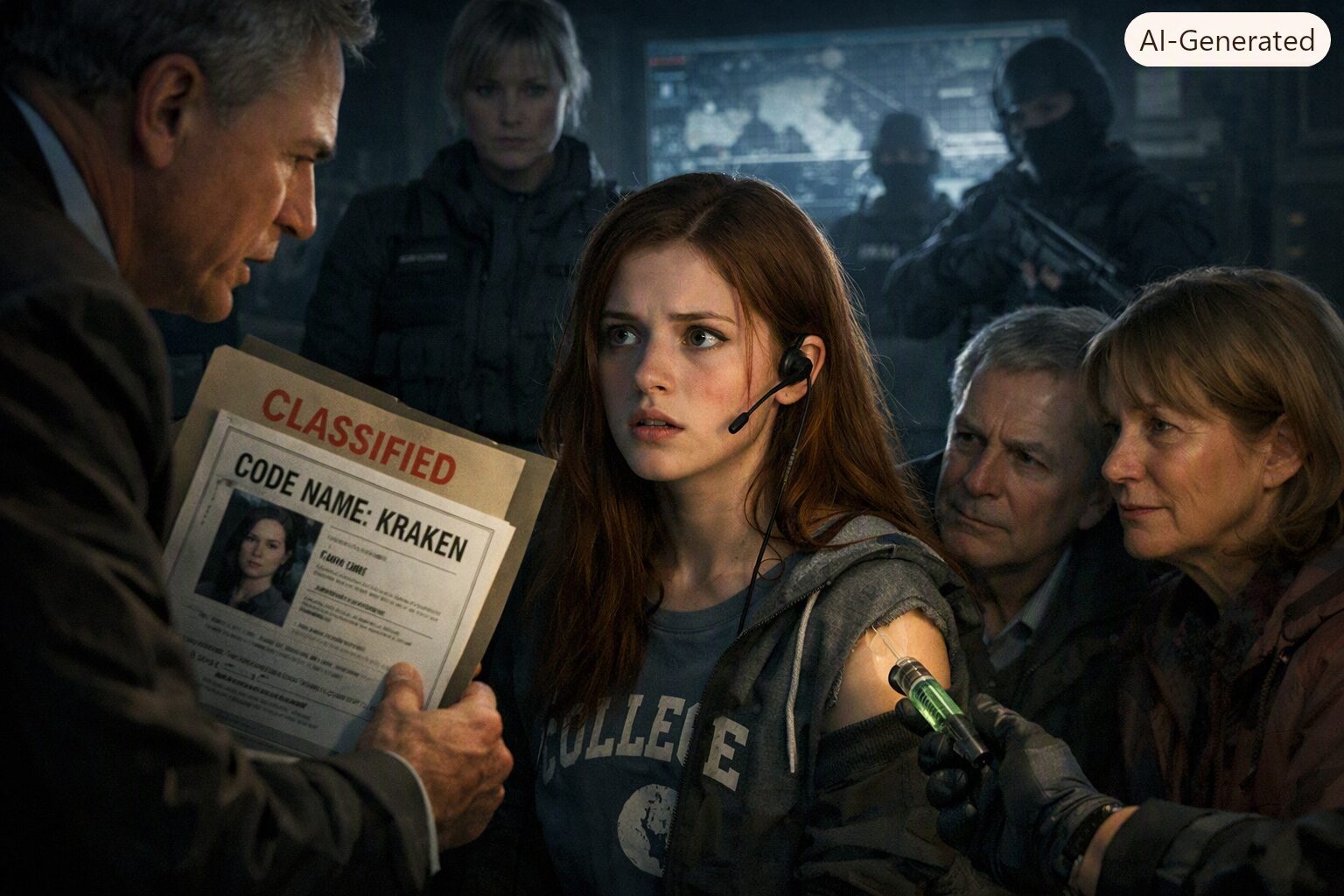
When truth surfaces, loyalty drowns.
A girl attending Parents’ Weekend is pulled into a covert Foundation assessment and discovers the family who raised her were never parents at all — just assets preparing her for activation as Code Name: KRAKEN.
Parent’s Weekend
I was halfway through planning my escape — the real kind, not the dramatic‑teenager kind — when someone behind me said,
“Hey, you looking to escape?”
I’d always felt like an extra in my own family, but I never expected the script to flip this hard.
I snapped around so fast my backpack nearly took out a freshman tour guide. The woman standing there looked like she’d lost a fight with a climbing wall — harness straps everywhere, goggles magnifying her eyes to anime proportions, a backward cap like she’d time‑traveled from 1997. A campus mascot for bad decisions.
“Depends,” I said. “Are you offering an escape or advertising one?”
Her grin was sharp. Too sharp.
“Either works,” she said. “But you’re late for your assessment.”
She turned and strode down a dim hallway, expecting me to follow. I did.
The Foundation
The hallway stretched longer than it should have, each fluorescent bulb flickering uncertainly. My footsteps echoed in a way that made me feel cataloged and logged.
Zipline didn’t look back — not to check if I was following or explain why Foundation chose Parents’ Weekend to collect investment.
“I see you still haven’t opened the envelope the Foundation sent,” she said over her shoulder.
I touched the sealed envelope in my pocket — the one I’d been pretending didn’t exist. It felt heavier than paper should. Like it knew something I didn’t.
She stopped at a steel door and punched in a sequence of codes that sounded like Pac‑Man being eaten alive. The lock clicked.
“Good,” she said. “Leave the contents sealed until the end of recruitment.”
“Why?”
“Free will. Choices. Or the stupid belief we have any.”
“Any what?”
She didn’t answer. The steel door groaned open.
And that’s when I realized — I wasn’t escaping Parents’ Weekend.
I was being recruited.
Assessment
The “Recruitment Center” was a converted gym, all fluorescent lights and folding tables, but the air felt wrong — too still, too expectant. A dozen parents milled around with clipboards, smiling the way people smile when they’ve been told to.
Even the air felt staged, like someone had briefed the oxygen on how to behave.
A banner hung crookedly over the bleachers:
WELCOME, FUTURE LEADERS!
The exclamation point felt hostile.
Tables were labeled Coordination, Endurance, Trust, but the volunteers manning them had the stiff posture of people who’d been briefed too many times. One woman held a clipboard upside down. Another kept glancing at the exits, waiting for a signal.
A boy about my age stood in a harness identical to mine; eyes glazed, lips moving silently like he was repeating instructions he wasn’t supposed to forget. When he noticed me watching, he straightened — not nervously, but obediently.
This wasn’t recruitment.
This was triage.
Containment
“Lift your arms,” the instructor said.
The harness tightened around my ribs until my breath thinned. Not recreational. Not for fun. This was containment gear — the kind built to keep someone compliant but mobile.
“You’re shaking,” he murmured.
“I’m evaluating,” I said.
They called it a “confidence climb,” but the wall was mapped like a breach route — red holds marking danger points, blue marking cover. Halfway up, a buzzer sounded, and the lights strobed, simulating disorientation. Parents cheered below, but their voices were too synced; a chorus trained to mask the real instructions beneath.
I dropped down early, boots hitting the mat harder than I meant. The room tilted. Something in me tilted with it.
I ducked behind a stack of foam mats just in time to hear my mother — not my mother — say, “The candidate is stabilizing. She’ll be ready for transfer by sixteen hundred.”
My father grunted. “And the boy?”
“He’ll get his placement. They always pay out.”
My ribs went cold inside the harness.
All those years of forced family dinners, staged vacations, the way they hovered without seeing me — it snapped into place with surgical clarity.
I wasn’t loved.
I was managed.
Activation
My mother’s voice — the woman who’d packed my lunches, who’d cried at my eighth‑grade graduation — sounded like she was reading from a script. Maybe she always had been.
A memory flickered: her hand on my shoulder the night before, squeezing just a little too long, memorizing me before she had to let go.
I wasn’t angry. Anger required surprise.
“Last test,” the harness‑woman said, tightening the final strap. “Don’t look down.”
I didn’t.
If they wanted a weapon, they should’ve been more careful about who they forged.
I looked forward — at the wall, at the route, at the future they’d been grooming me for without my consent.
And I climbed.
Code Name: Kraken
I finally pull the envelope from my pocket, tear it open, and unfold the single sheet inside.
Still warm.
CC: CODE NAME — KRAKEN, stamped in blocky black type — bureaucrats pretending they’re not afraid.
Across the quad, the family that was never mine stands in a neat little triangle. The mother’s hands clamp her son’s shoulders like she’s afraid he’ll blow away. The father keeps scanning the crowd, looking for someone who isn’t me.
Assets.
That’s all they ever were.
They were told to house me, feed me, keep me alive until the Foundation came for me. In exchange, Golden Boy would get funneled into one of the top three Ivies.
A clean trade.
Job well done, I think as I cross the courtyard.
The mother catches my eye and gives a nervous nod — the kind people give dangerous animals they hope won’t bite.
I walk past them without slowing.
Recruited. Assessed. Deployed.
Kraken, activated.
Judge Commentary
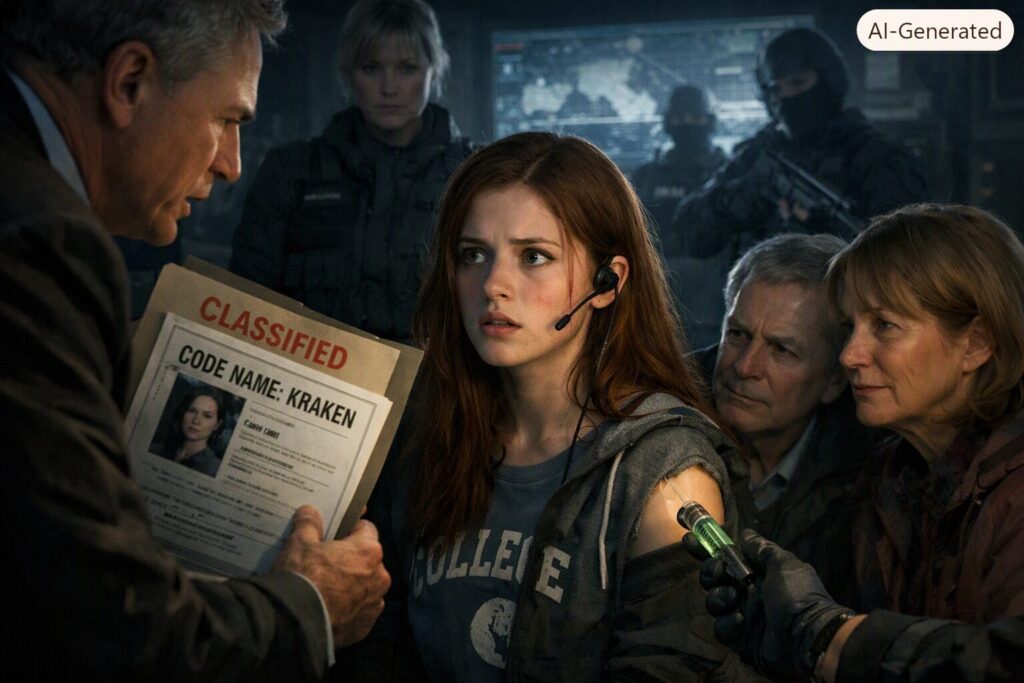
What the Judges Loved
{2206} — Voice, Wit, Atmosphere They zeroed in on your narrator’s observational sharpness — the way she weaponizes wit to cut through the surreal staging around her. They loved the climbing‑wall woman, the hostile exclamation point, the paper that “felt like it knew something.” They felt the atmosphere was deeply unsettling in a way that felt intentional and controlled.
{2482} — Authentic College‑Age Voice & Emotional Credibility This judge praised how convincingly you wrote a college‑aged protagonist — independent but still tethered to the idea of parental support. They highlighted the emotional devastation of realizing her parents were handlers, especially the shoulder‑squeeze memory. They believed her reactions, her agency, her internal logic.
{2550} — Imagery, World‑Building, Similes This judge loved your imagery: Pac‑Man being eaten alive, oxygen being briefed. They saw these moments as distinct, original, and tonally effective — adding levity without breaking tension. They praised the world‑building as intriguing and unique.
Author’s Note
Thank you for spending time inside CC: Code Name — KRAKEN. Written for the NYC Midnight Flash Fiction Challenge (Spy category), this story lives in the moment when identity tilts and the world reveals what it’s been hiding in plain sight. I’m always curious what readers notice first — the atmosphere, the rupture, the voice, the shift in her understanding. Tell me what rose to the surface for you.
Leave a Reply