Why We Pretend Not to See What’s Right in Front of Us
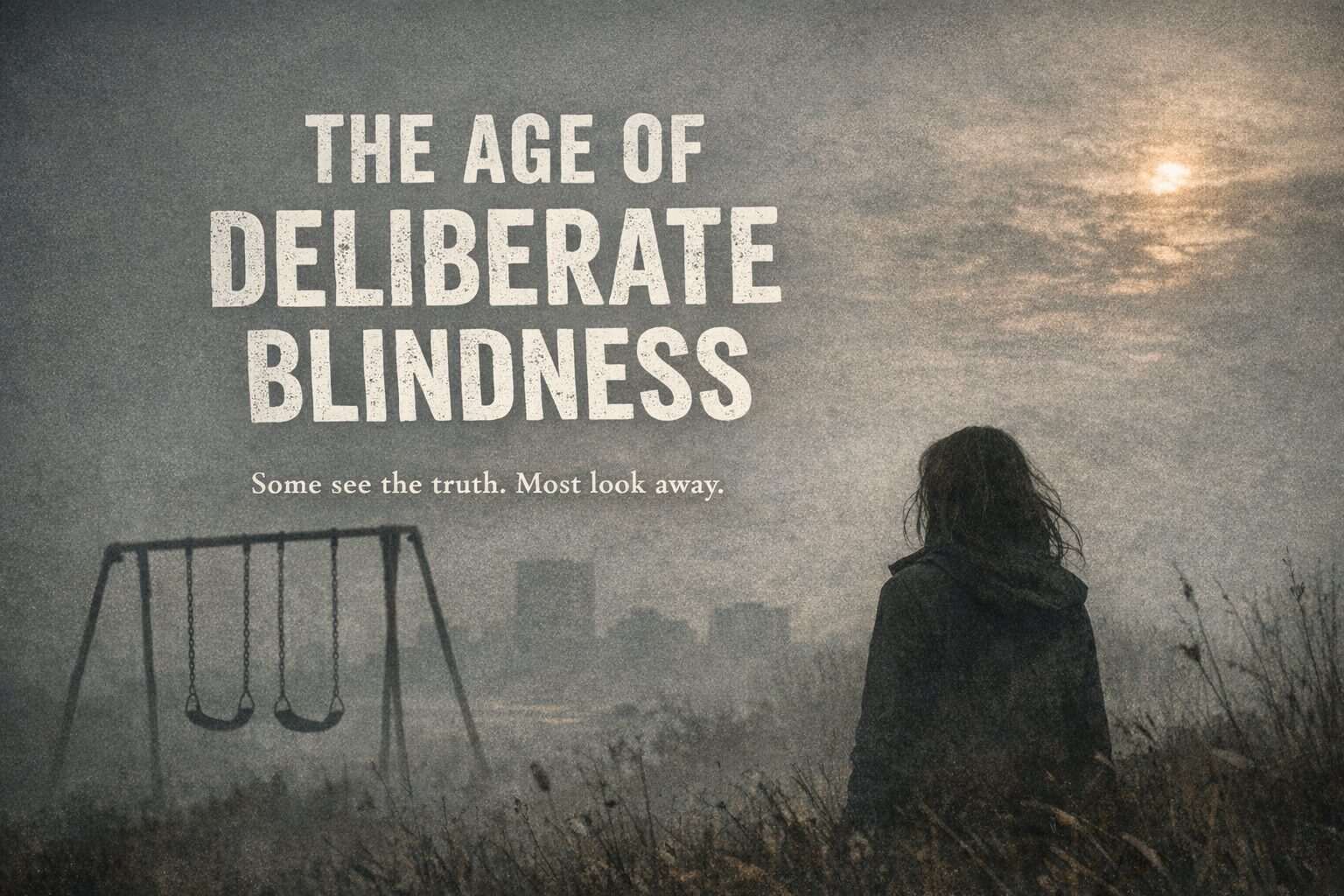
We’re living in an era where people look straight at the truth and choose not to see it. This piece is a reckoning with the cultural performance of blindness — and the cost paid by those who can’t look away.
Some patterns don’t whisper. They thunder. And still, people pretend they hear nothing.
We are not living in an age of confusion.
We are living in an age of deliberate blindness — a cultural reflex so widespread it’s practically ritual. People look directly at the truth, recognize it, feel its heat on their skin, and still choose to look away.
Not because they can’t see.
Because they don’t want to.
The pattern is now visible to everyone.
Even the most conventionally wired minds — the ones who rely on social cues, majority consensus, or institutional reassurance — can see it. The repetition is too loud. The consequences are too consistent. The trajectory is too predictable.
And yet the dominant response is still a collective shrug, a muttered “Well, I’m not sure…” as if uncertainty is a shield strong enough to deflect reality.
Uncertainty isn’t the problem.
Cowardice is.
THE PATTERN ISN’T SUBTLE ANYMORE
There was a time when you could argue the signs were faint or the connections unclear. That time is gone. The world is loud now. Patterns repeat with the precision of a metronome. The same mistakes, the same denials, the same spirals, the same outcomes — over and over, like a prophecy no one wants to admit is unfolding.
This isn’t niche.
This isn’t hidden.
This isn’t “only the neurodivergent notice.”
Everyone sees it.
But visibility doesn’t equal acknowledgment.
Seeing something and admitting you see it are two different acts.
Most people stop at the first one.
They see the pattern.
They feel the discomfort.
They sense the implications.
And then they choose denial.
“In a culture built on selective blindness, seeing clearly becomes an act of rebellion.”
THE CULTURE OF SELECTIVE BLINDNESS
Selective blindness is not passive. It’s an active choice — a psychological contortion that lets people maintain the illusion of stability while the ground shifts beneath them.
It sounds like this:
- “I didn’t know.”
- “I’m not sure what’s happening.”
- “It’s complicated.”
- “Let’s not jump to conclusions.”
These are not statements of confusion.
They’re escape hatches.
Neutrality has become the new opiate — a way to numb the conscience just enough to avoid discomfort. But neutrality isn’t neutral. It’s alignment with the status quo, even when the status quo is harmful.
And the people who refuse to play along — the pattern-trackers, the truth-noticers, the ones whose brains refuse to let a contradiction slide — are treated as the problem.
Not because they’re wrong.
Because they break the spell.
THE BURDEN OF THE NOTICER
There is a particular exhaustion that comes from being wired to see what others work so hard to ignore. Pattern recognition isn’t a hobby; it’s a neurological inevitability. Some brains are built to track trajectories, map consequences, and notice the shift in the air before the storm arrives.
These are the people who say, “This is going to happen,” and are met with eye rolls — right up until the moment it happens.
Then, suddenly, the truth becomes obvious to everyone.
Not because it changed, but because someone with a higher social status finally said it out loud.
This is the hierarchy of credibility at work:
Truth doesn’t matter until the “right” person speaks it.
And the noticers — the ones who saw it first, who named it early, who tried to warn others — are dismissed, minimized, or outright ignored. Their clarity is treated as a nuisance. Their insight is treated as arrogance. Their accuracy is treated as aggression.
Because in a culture built on selective blindness, seeing clearly is an act of rebellion.
THE MYTH OF NOT KNOWING
Let’s be honest:
Most people know exactly what they’re doing.
They know when they’re avoiding a truth.
They know when they’re ignoring a pattern.
They know when they’re choosing comfort over clarity.
The myth of “not knowing” is a convenient shield — a way to dodge accountability while maintaining the illusion of innocence.
But innocence built on avoidance is not innocence.
It’s complicity.
And complicity, repeated enough times, becomes culture.
We are living in a culture of people who would rather pretend not to see than confront the discomfort of recognition.
THE COST OF LOOKING AWAY
The cost of this collective denial is not abstract. It accumulates in small cruelties, repeated injustices, predictable collapses — all of which could have been prevented if people had simply acknowledged what they already knew.
When people choose not to see, someone else pays the price.
Often, it’s the noticers — the ones who can’t look away, who can’t unsee, who can’t pretend. They become the emotional shock absorbers for a society that refuses to face itself.
They carry the weight of truth alone.
And the irony is that they’re punished for it.
THE TRUTH DOESN’T NEED PERMISSION
The truth is not waiting for consensus.
It doesn’t need a majority vote.
It doesn’t require social approval.
It stands there, patient and immovable, like a mythic figure in the doorway — arms open, waiting for someone to acknowledge it.
Some will walk past it every day and pretend it isn’t there.
Some will glance at it and quickly look away.
Some will wait for someone with authority to point at it first.
And some — the pattern-seers, the truth-bearers, the ones wired for clarity — will look it in the eye and say, “I see you.”
These are the people who break cycles.
These are the people who disrupt the loop.
These are the people who refuse to participate in the cultural performance of blindness.
They are not the problem.
They are the antidote.
THE ERA OF LOOKING AWAY IS ENDING
The world is shifting.
The patterns are louder.
The consequences are closer.
The truth is harder to ignore.
We are approaching a point where selective blindness will no longer be a viable survival strategy. The cost is too high. The stakes are too visible. The repetition is too exhausting.
The era of looking away is ending.
And the people who have been seeing all along — the ones dismissed as dramatic, abrasive, or “too much” — will be the ones who guide us through what comes next.
Not because they want to.
Because they have to.
Because they always have.
Author’s Note
Thank you for reading this piece. It came from the part of me that refuses to pretend not to see what’s right in front of us — the part that still believes clarity is a form of courage.
So tell me—what truth have you been carrying that others keep choosing not to see?
Leave a Reply