
“Claiming ‘writer’ wasn’t a beginning. It was a return to the truth I’d been carrying since sixteen.”
I wish I could remember her name.
What I do remember is walking into her classroom at sixteen, sitting in the front row with first‑day jitters in a new school, trying to make myself smaller than I already felt. She was a kind, middle‑aged woman with cotton‑white hair and burgundy‑rimmed glasses, and she greeted me with a smile that didn’t feel performative. She had the sort of presence that made you believe she actually saw the students in front of her, not just the roster.
I was insecure, unmoored, and convinced I didn’t fit anywhere — not at home, not in or out of school, not even in my own skin. I had no idea, as I pulled out my spiral notebook with ENGLISH written in thick black Sharpie, that this moment would become part of my origin story.
The First Naming
The first assignment was nothing dramatic: a personal essay, the kind teachers give to gauge where everyone is. I wrote mine the way I wrote everything back then — quietly, intensely, as if the page were the only place I was allowed to tell the truth.
When she handed it back, she paused. Not long enough to draw attention, but long enough for me to notice. She tapped the margin and said:
“You have a voice.”
Not good job. Not nice work. A naming. A recognition. A sentence that rearranged the furniture in my chest.
At sixteen, you don’t expect adults to take you seriously. You expect correction, dismissal, or the usual warnings to be realistic. But she treated my words like they mattered — like I mattered — and that was a shock to a kid who had spent most of her life trying not to take up space.
I didn’t understand the magnitude of it then, but I do now: she handed me back my own voice and told me it was worth listening to.
The Second Naming
About a month into the semester, I finally worked up the courage to approach her after class. I lingered by her desk, pretending to reorganize my things while the last of my classmates drifted out. I clutched my spiral notebook to my chest, the metal wire biting into my palms.
She looked up, glasses slipping slightly down her nose, and said my name with a softness that startled me. Not the clipped roll‑call version. Not the mispronounced version I’d grown used to correcting. She said it like it belonged to me.
“What’s on your mind?” she asked.
I wasn’t brave enough to tell her what her comment meant to me. But I was brave enough to stand there. Brave enough to let myself be seen for a heartbeat longer than usual.
She noticed the notebook. “Hey, Christine,” she said. “What do you have there?”
At sixteen, everything is life or death — every word, every silence, every risk of being seen.
“It’s… just something I wrote,” I said.
She didn’t rush me. She didn’t fill the silence. She simply waited, hands folded, eyes kind. It was the first time an adult had ever given me that kind of space — the kind that says, Take your time. I’m not going anywhere.
“Can I see?” she asked.
Three ordinary words. But they hit me like a tectonic shift.
She read the first few lines, then looked up with an expression I didn’t yet have the vocabulary for. Not praise. Not approval. Recognition.
“Christine,” she said, tapping the margin, “you think like a writer.”
Not you write well. Not this is good. You think like a writer.
It was the first time anyone had ever named the thing I had been carrying alone. The first time I felt the possibility — faint, trembling, but real — that writing wasn’t a phase or a quirk. It was a way of being.
That sentence lodged itself under my ribs and stayed there.
The Long Silence Between Then and Now
It would be almost four decades before I believed her.
I’ve always been a writer; I just didn’t know I was allowed to say it out loud. Not when I was sixteen and learning to fold myself into smaller shapes. Not in my twenties, when practicality drowned out possibility. Not in my thirties, when life demanded versions of me that had nothing to do with the girl clutching a spiral notebook like a lifeline.
Her sentence followed me through every false start, every abandoned draft, every year I spent pretending writing was a hobby instead of the pulse beneath everything I did. It was a quiet, persistent echo — a truth waiting for me to grow into it.
The Return
January 21, 2022 didn’t arrive with fireworks or fanfare. It wasn’t a milestone birthday or a crisis. It was quieter than that — the kind of quiet that feels like truth clearing its throat.
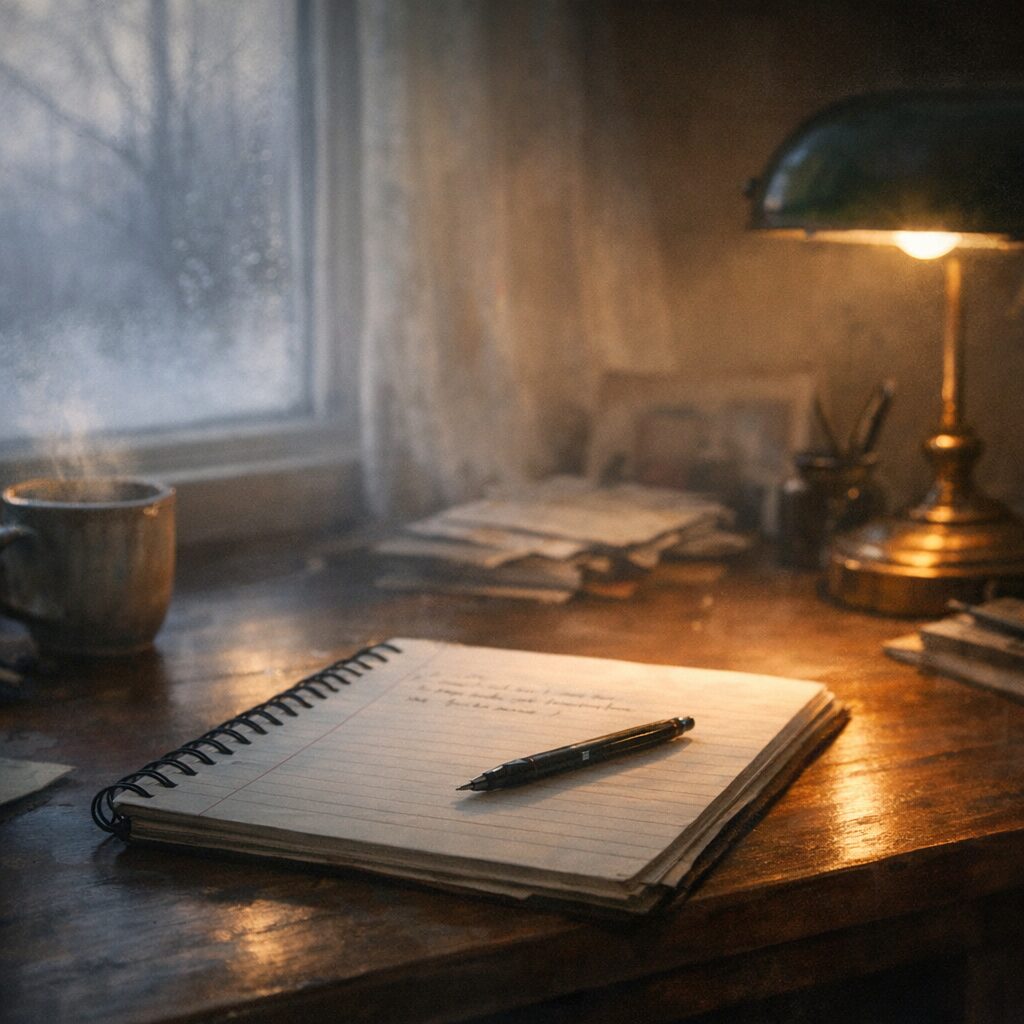
I remember sitting at my desk, winter light slanting across the room, and realizing I was tired. Tired of minimizing. Tired of apologizing. Tired of treating the thing that had carried me through every version of my life as if it were an indulgence instead of a calling.
I opened a blank document, the cursor blinking like a pulse, and for the first time in decades, I didn’t flinch from the word that had been following me since that classroom in Niskayuna.
Writer.
I said it out loud — not a whisper, not a question, but a statement. A naming. A return.
Claiming the title wasn’t about confidence or publication or permission. It was about finally acknowledging the truth that had been living under my ribs since that day in high school.
The Shift
Claiming writer changed how I approached being seen — and not seen.
Before 2022, visibility felt like a test I was always failing. Silence felt like confirmation of every insecurity I’d carried since that sixteen‑year‑old girl in the front row. If a post didn’t get attention, I assumed it meant something about me.
But once I claimed the title, the landscape shifted.
I stopped treating my work like something fragile that needed validation to survive. I stopped performing for the feed. I stopped contorting my voice into something algorithm‑friendly.
Silence stopped feeling like a verdict. It became information. It became clarity.
I write for people who want to sit down and stay awhile. People who want depth, not dopamine. People who want to linger, not swipe.
And once I accepted that, I stopped chasing the kind of visibility that evaporates in seconds. I started valuing the kind that feels like someone pulling up a chair.
The Truth of It
January 21, 2023 wasn’t the day I became a writer. It was the day I stopped pretending I wasn’t one.
Author’s Note
Some stories arrive as echoes — not new, but remembered. This one began in a classroom decades ago and found its way back through winter light and quiet reclamation. I write these pieces as a way of tracing the long arc between silence and voice, between the girl who folded herself small and the woman who finally said the word out loud. If you’ve found your way here, thank you for sitting with the quiet. This space is built for it.
So tell me — what moment first told you that your voice was worth listening to?
Leave a Reply